A common topic in ontologies of Crusius’ time, not that usual in modern ontologies, is quantities - back then, general philosophers were keen to explain what mathematics is all about, while nowadays this question is more and more left for special branch called philosophy of mathematics. Crusius follows the tradition and starts by defining quantity as such a property of a thing, by which something is posited more than once.
Crusius notes that at least complex concrete things naturally have a quantity - they consist of many things. Furthermore, even simple concrete things have quantifiable features - they have forces, and even though they are indivisible, they still are spatial and thus have some magnitude. Then again, some abstractions are not quantifiable, Crusius says: there are no levels of existence, but all existing things exist as much as others. Crusius also notes in passing the possibility of infinite quantities, but at once declares that we finite beings cannot really know anything about them.
Quantities come in different types, Crusius continues, for instance, quantity of a force differs from a quantity of an extension. The difference between these types becomes important, when we start to measure the quantities. Measuring, Crusius says, involves determining a relation of a quantity to some known quantity. As such, this kind of comparison is possible only between quantities of the same type (there’s no sense in measuring weight with a ruler). Still, Crusius admits, quantities of different type can be compared indirectly. Firstly, we can compare them through relations of quantities - for instance, we can say that punishments should be proportional to the crimes punished. Secondly, the comparison can be done through causal links, for example, the resistance of a body can be compared with the striving of a soul, because one has the effect of hindering the other.
To determine a quantity perfectly, Crusius says, we must represent its parts distinctly. This requires expressing the quantity as a number of distinctly thought units. These units might be naturally distinct - for instance, when we count things distinguished by natural limits, like cows - or arbitrarily chosen, for example, when we compare length of a thing to a measuring stick. Since a given quantity might not be expressible as a number of arbitrarily chosen units, Crusius also introduces fractions (no mention of irrational numbers, though).
An extreme case of natural units, for Crusius, is naturally provided by simple substances. Crusius admits that measuring complex substances by their simple parts is impossible, since we do not perceive these ultimate constituents. Still, he continues, understanding the nature of these simple parts can help us in picking suitable units for measurement: for instance, when we note that movement should be ideally measured by checking how many simple substances move through smallest measures of space, we can surmise that movement could be measured by checking how many things move through a certain space.
Crusius spends the majority of the rest of the chapter discussing a hotly debated topic of the time, namely, the so-called question of living forces. The point of the debate, at least as conceived by Crusius, is how to measure the quantity of an action, such as movement. Crusius’ take is that while abstractly taken this quantity can be expressed as a multiple of the strength of the action (in case of movement, mass of the moving object) and its velocity, we must also account for the resistance encountered by the action and thus use the square of velocity to determine the action.
Näytetään tekstit, joissa on tunniste forces. Näytä kaikki tekstit
Näytetään tekstit, joissa on tunniste forces. Näytä kaikki tekstit
maanantai 29. elokuuta 2022

keskiviikko 22. kesäkuuta 2022
Christian August Crusius: Draft of necessary truths of reason, in so far as they are set opposite to contingent ones - Forces and activities
All things make other things possible and are therefore causes, Crusius says. This possibility of another thing could be called a force. Problem with this definition, Crusius says, is that such forces seem to explain nothing: it does not really tell us anything to say that the stomach has a force to consume food. Indeed, such a force might be a combination of many causes or then it might be just an abstraction of some more substantial process.
For this reason, Crusius advocates looking for forces in a more substantial sense or fundamental forces (Grundkraft). These fundamental forces should be something special and distinct even outside our consideration and also something constant in the thing. When then can we say that something is a fundamental force? Well, Crusius notes, as long as we cannot causally explain the supposed effects through the force, this cannot be fundamental - or at least we do not understand the fundamental force distinctly. This means that at least the first or nearest effects of the fundamental force should be affected only by conditions within the subject. In fact, these nearest effects should be something in the subject itself, while further effects appearing in other things or objects are influenced also by fundamental forces in those objects.
Crusius continues determining fundamental forces. If a fundamental force is finite, it should have only one kind of nearest effect, while all further effects should be understood through these nearest effects - otherwise, causal chains would offer no explanation. Of course, the same finite subject can have several distinct fundamental forces and could thus be part of many kinds of causal chains with many types of nearest effects. Furthermore, the limitation affects even less an infinite force, Crusius says, because it should be capable of literally all kinds of effects. This implies that we can never really know what having an infinite force would feel like.
Fundamental force should be truly fundamental, Crusius emphasises. In other words, it should not be causally dependent on some other forces in the same subject nor be just a modification of some force. Then again, if one knows that some occurrence in a subject cannot be explained through one force, then this occurrence cannot be just a modification of this one force, but requires the influence of some other force. For instance, Crusius suggests against Wolff, human volition cannot be explained through mere force of representation.
Forces can cause something through their mere existence, Crusius says and gives as examples all mechanical causes that affect things through their mere position and shape. Then again, force can also be active in the sense that it affects things through an inner property directed to bring about certain effects. Such activities can form causal chains within a subject, Crusius notes, but these chains must end in some fundamental activities, which are immediate applications of some fundamental forces. These fundamental activities cannot be mechanical, thus, cannot depend on mere movement of the subjects. Furthermore, they cannot depend on anything external to the subject nor be generated merely by a previous activity of the subject, although previous activities can be conditions of a fundamental activity.
Crusius notes that some fundamental activities continue constantly, because of the essence of the underlying substance. In the case of divine activities, Crusius insists, the very underlying substance is necessary and thus the activities are also necessary. If the underlying substance is not necessary, like in case of elements, the fundamental activity is dependent on its existence.
Some fundamental activities do not occur constantly, Crusius says. Of these contingent fundamental activities, some happen always in a certain manner under certain conditions, like human sensations. Then again, other fundamental activities are just enabled by certain conditions, but not necessarily actualised: the primary example here is human will. Crusius insists that such free activities are not contradictory, and indeed, that their existence must be assumed, in order to justify the notion of moral accountability.
Free activities can be sufficient grounds, Crusius says, in the sense that they can make things actual. Then again, he continues, they are not determining grounds, that is, what they make actual could also be otherwise. In cases not involving free activities, Crusius endorses what he calls the principle of determining ground: what is not generated through free action must have a ground that not just makes it actual, but also determines it to be such and not otherwise.
The principle of determining ground concerns only real grounds, in other words, relations between real substances. Thus, Crusius explains, it should not be confused with an epistemic principle that nothing should be assumed without a good ground or reason or with a moral principle that nothing should be done without a good reason. Still, determining grounds do provide us also with ideal or epistemic grounds, he admits: if we know that something is a determining ground for some phenomenon, we know that this phenomenon cannot be otherwise.
For this reason, Crusius advocates looking for forces in a more substantial sense or fundamental forces (Grundkraft). These fundamental forces should be something special and distinct even outside our consideration and also something constant in the thing. When then can we say that something is a fundamental force? Well, Crusius notes, as long as we cannot causally explain the supposed effects through the force, this cannot be fundamental - or at least we do not understand the fundamental force distinctly. This means that at least the first or nearest effects of the fundamental force should be affected only by conditions within the subject. In fact, these nearest effects should be something in the subject itself, while further effects appearing in other things or objects are influenced also by fundamental forces in those objects.
Crusius continues determining fundamental forces. If a fundamental force is finite, it should have only one kind of nearest effect, while all further effects should be understood through these nearest effects - otherwise, causal chains would offer no explanation. Of course, the same finite subject can have several distinct fundamental forces and could thus be part of many kinds of causal chains with many types of nearest effects. Furthermore, the limitation affects even less an infinite force, Crusius says, because it should be capable of literally all kinds of effects. This implies that we can never really know what having an infinite force would feel like.
Fundamental force should be truly fundamental, Crusius emphasises. In other words, it should not be causally dependent on some other forces in the same subject nor be just a modification of some force. Then again, if one knows that some occurrence in a subject cannot be explained through one force, then this occurrence cannot be just a modification of this one force, but requires the influence of some other force. For instance, Crusius suggests against Wolff, human volition cannot be explained through mere force of representation.
Forces can cause something through their mere existence, Crusius says and gives as examples all mechanical causes that affect things through their mere position and shape. Then again, force can also be active in the sense that it affects things through an inner property directed to bring about certain effects. Such activities can form causal chains within a subject, Crusius notes, but these chains must end in some fundamental activities, which are immediate applications of some fundamental forces. These fundamental activities cannot be mechanical, thus, cannot depend on mere movement of the subjects. Furthermore, they cannot depend on anything external to the subject nor be generated merely by a previous activity of the subject, although previous activities can be conditions of a fundamental activity.
Crusius notes that some fundamental activities continue constantly, because of the essence of the underlying substance. In the case of divine activities, Crusius insists, the very underlying substance is necessary and thus the activities are also necessary. If the underlying substance is not necessary, like in case of elements, the fundamental activity is dependent on its existence.
Some fundamental activities do not occur constantly, Crusius says. Of these contingent fundamental activities, some happen always in a certain manner under certain conditions, like human sensations. Then again, other fundamental activities are just enabled by certain conditions, but not necessarily actualised: the primary example here is human will. Crusius insists that such free activities are not contradictory, and indeed, that their existence must be assumed, in order to justify the notion of moral accountability.
Free activities can be sufficient grounds, Crusius says, in the sense that they can make things actual. Then again, he continues, they are not determining grounds, that is, what they make actual could also be otherwise. In cases not involving free activities, Crusius endorses what he calls the principle of determining ground: what is not generated through free action must have a ground that not just makes it actual, but also determines it to be such and not otherwise.
The principle of determining ground concerns only real grounds, in other words, relations between real substances. Thus, Crusius explains, it should not be confused with an epistemic principle that nothing should be assumed without a good ground or reason or with a moral principle that nothing should be done without a good reason. Still, determining grounds do provide us also with ideal or epistemic grounds, he admits: if we know that something is a determining ground for some phenomenon, we know that this phenomenon cannot be otherwise.
torstai 8. maaliskuuta 2018
Joachim Darjes: Elements of metaphysics 1 - Monads without spontaneity equals elements
After ontology, Darjes turns his attention to monadology, which in his philosphy means two things: firstly, a discipline for the study of simple entities in general, and secondly, particularly study of those simple entities, which constitute complex entities, or elements. It is just natural to start with the general part.
Now, the essence of any simple entity, Darjes begins, consists of two things. Firstly, as simple it is indivisible or does not consist of further entities. Secondly, an an entity it is impenetrable or it cannot be a determination of any other entity. Just like in all previous Wolffian philosophy, because of its simplicity, a simple entity cannot have been generated from previously existing entities that would retain their existence even after the generation of new entity. Instead, a generated simple entity would have to have appeared instantaneously out of nothing. Similarly, when a simple entity is destroyed, it will be completely annihilated.
Another commonplace with earlier Wolffians is the importance of force as a basic characteristic of simple entities. For instance, because a simple entity does not consist of many entities, the only way quantities can be applied to it is through the strength or intensity of its basic force. What is more original is Darjes' attempt to use the notion of force as a way to divide simple entities into further genera. Some forces do not act by themselves, but require still some efficient cause to activate them – simple entities with such forces Darjes calls passive. Some forces require only a removal of obstacles for their activation – simple entities with such forces Darjes calls active. And it wouldn't be a Darjesian division, if he wouldn't note the possibility of a third genera, with simple entities with both active and passive characteristics, although in practice he doesn't mention them often.
The essence of passive simple entities in Darjesian philosophy is simple. By themselves, they do nothing. They can be activated by impenetrability of other simple entities, which move to the place where the passive entity is and thus force it to move away from its original location. After this, the passive entity acts, that is, it moves, and cannot stop from moving, unless something external stops it. In effect, a passive simple entity isn't spontaneous, that is, it cannot determine itself to act.
Active entities, on the other hand, might be spontaneous. Yet, it is also possible, Darjes says, that an active entity is not spontaneous, in other words, it might require only removal of obstacles for its own activity, but perhaps cannot itself remove those obstacles. In case of spontaneous simple entities, on the other hand, these obstacles come mainly from the entity itself – in a sense they forbid themselves of doing things. Spontaneous entities can remove such a self-imposed obstacle and thus, in a sense, choose to do something. In other words, they act first on themselves and through this self-action act toward other things. Darjes suggests that this self-action happens always through representations or perceptions – the simple entity perceives some goal as good, that is, as conforming to its essence, and proceeds to actualise that goal.
After defining the three species of simple entities – passive, non-spontaneously active and spontaneous simple entities – Darjes goes on to discuss their possible interactions with one another. In case of mere passive entities, these interactions – mostly collisions – happen according to the laws of motion, which had been a hot philosophical topic since the time of Descartes. The introduction of active entities complicates interactions, even when the active entities are not spontaneous, since a collision might not just force an active entity to move, but also to remove impediments for natural movement of the entity. In case of a spontaneous simple entity, finally, other entities cannot really make it do anything, but merely provide an occasion for the spontaneous entity to do something.
An important relation between simple entities in Darjesian scheme is coherence, that is, a relation of proximity in which the simple entities have become so unified that one cannot be moved without moving the other. For such a coherence it is not enough that the simple entities just lie passively side by side, Darjes notes, because then one of them could be simply moved without any change in the other. Instead, the diverse entities must act on one another and this act cannot be mere movement – in other words, they must somehow attract one another. Thus, at least some of the cohering entities must be naturally active. Then again, Darjes notes, a spontaneous simple entity cannot really cohere with other simple entities, because other entities can at most provide an occasion for it to act. These results are important especially for the special part of Darjesian monadology, because Darjes thinks that unified bodies are essentially constituted from simple entities by coherence. Hence, elements – simple entities constituting bodies – cannot be spontaneous. Furthermore, because infinite entity must be most perfect in every sense, and like many philosophers before him, Darjes regards activity and especially spontaneity as more perfect than passivity, all elements are revealed to be finite.
Now, the essence of any simple entity, Darjes begins, consists of two things. Firstly, as simple it is indivisible or does not consist of further entities. Secondly, an an entity it is impenetrable or it cannot be a determination of any other entity. Just like in all previous Wolffian philosophy, because of its simplicity, a simple entity cannot have been generated from previously existing entities that would retain their existence even after the generation of new entity. Instead, a generated simple entity would have to have appeared instantaneously out of nothing. Similarly, when a simple entity is destroyed, it will be completely annihilated.
Another commonplace with earlier Wolffians is the importance of force as a basic characteristic of simple entities. For instance, because a simple entity does not consist of many entities, the only way quantities can be applied to it is through the strength or intensity of its basic force. What is more original is Darjes' attempt to use the notion of force as a way to divide simple entities into further genera. Some forces do not act by themselves, but require still some efficient cause to activate them – simple entities with such forces Darjes calls passive. Some forces require only a removal of obstacles for their activation – simple entities with such forces Darjes calls active. And it wouldn't be a Darjesian division, if he wouldn't note the possibility of a third genera, with simple entities with both active and passive characteristics, although in practice he doesn't mention them often.
The essence of passive simple entities in Darjesian philosophy is simple. By themselves, they do nothing. They can be activated by impenetrability of other simple entities, which move to the place where the passive entity is and thus force it to move away from its original location. After this, the passive entity acts, that is, it moves, and cannot stop from moving, unless something external stops it. In effect, a passive simple entity isn't spontaneous, that is, it cannot determine itself to act.
Active entities, on the other hand, might be spontaneous. Yet, it is also possible, Darjes says, that an active entity is not spontaneous, in other words, it might require only removal of obstacles for its own activity, but perhaps cannot itself remove those obstacles. In case of spontaneous simple entities, on the other hand, these obstacles come mainly from the entity itself – in a sense they forbid themselves of doing things. Spontaneous entities can remove such a self-imposed obstacle and thus, in a sense, choose to do something. In other words, they act first on themselves and through this self-action act toward other things. Darjes suggests that this self-action happens always through representations or perceptions – the simple entity perceives some goal as good, that is, as conforming to its essence, and proceeds to actualise that goal.
After defining the three species of simple entities – passive, non-spontaneously active and spontaneous simple entities – Darjes goes on to discuss their possible interactions with one another. In case of mere passive entities, these interactions – mostly collisions – happen according to the laws of motion, which had been a hot philosophical topic since the time of Descartes. The introduction of active entities complicates interactions, even when the active entities are not spontaneous, since a collision might not just force an active entity to move, but also to remove impediments for natural movement of the entity. In case of a spontaneous simple entity, finally, other entities cannot really make it do anything, but merely provide an occasion for the spontaneous entity to do something.
An important relation between simple entities in Darjesian scheme is coherence, that is, a relation of proximity in which the simple entities have become so unified that one cannot be moved without moving the other. For such a coherence it is not enough that the simple entities just lie passively side by side, Darjes notes, because then one of them could be simply moved without any change in the other. Instead, the diverse entities must act on one another and this act cannot be mere movement – in other words, they must somehow attract one another. Thus, at least some of the cohering entities must be naturally active. Then again, Darjes notes, a spontaneous simple entity cannot really cohere with other simple entities, because other entities can at most provide an occasion for it to act. These results are important especially for the special part of Darjesian monadology, because Darjes thinks that unified bodies are essentially constituted from simple entities by coherence. Hence, elements – simple entities constituting bodies – cannot be spontaneous. Furthermore, because infinite entity must be most perfect in every sense, and like many philosophers before him, Darjes regards activity and especially spontaneity as more perfect than passivity, all elements are revealed to be finite.
tiistai 23. tammikuuta 2018
Joachim Darjes: Elements of metaphysics 1 - Forceful being
We have been studying what Darjes calls primary philosophy, but we finally come to his ontology, when we see his definition of an entity (ens). In effect, by an entity Darjes means something that is not accident, that is, which can be in itself. What this being in itself means, according to Darjes, is at least that in the same place as one entity exists, no other entity can exist. Thus, impenetrability of an entity is an ontological characteristic for Darjes, while accidents might share the same place by occurring in same entity. An entity need not exist, but it can be a merely possible entity. If it does exist, Darjes calls it a substance.
Darjes notes that all substances can contain something which is a reason for something else being what it is. In other words, they are forces that can act on other things. Now, because this activity is an essential part of what substances are, they can also be divided according to their level of activity. The highest kind of substance is completely active and needs at most something to remove obstacles from its way to start acting – they are what Darjes calls an effective conatus. At the lowest rang of substances are completely passive substances, which require some efficient reason to make them act – these are what Darjes calls bare potentia. Between these two extremes fall cases where substances are in some sense passive and in some sense active – these substances Darjes calls either ineffective conatuses or potentias with conatus (it is difficult to say whether Darjes means these two to be separate groups, depending on whether the emphasis is on the active or the passive side of the substance or whether they are just two names for the same thing).
Darjes does not just distinguish between different kinds of forces or substances, but also between different kinds of actions these substances can make occur. The actions might happen within the substances or be intrinsic to it – these would be immanent actions. Then again, the actions might also be extrinsic to the substance – these would be transitive actions. Of course, Darjes also admits that some actions might be partially immanent and partially transitive.
Like all Wolffians, Darjes is a nominalist who insists that no universals can exist. Hence, all substances must be individuals. Although substances cannot then be divided into universals and individuals, Darjes does divide them into complete and incomplete substances, depending on whether a substance acts or not. He also notes that a substance can be variably or contingently complete, if it sometimes happens to act and sometimes not. Even if a substance would be contingently complete, it still might be a necessary existent, since there is no necessity that a necessary existent would always act.
A notion near to completeness is the subsistence of a substance. Darjes defines subsistent substance as a complete substance that is not sustained by something else. Here, sustaining means a relation in which one force determines another to act in a precise manner. Thus, subsisting substance would act and not be acted upon by other substances.
Darjes goes on to define states of an entity. In effect, these are nothing more than collections of some determinations that the entity has. For instance, being a substance or substantiality and subsistence are states that some entity might have. Depending on the determinations making up the state, the state can be internal, external or mixed, and it can be necessary or contingent. For instance, if there are some entities existing absolutely necessarily, then they have an absolutely necessary state of substantiality. With contingent entities, on the other hand, their state of substantiality is also contingent and in fact depends ultimately on some absolutely necessary substance.
Darjes does not remain on mere level of definitions, but tries to determine some general characteristics true of all substances, based mostly on the principle of sufficient reason. The most important conclusion is that all substances must persevere in their state of action or non-action, until some further reason makes them change their state. Thus, an action continues, until something comes to impede it.
Darjes also spends some time considering how to quantify forces. His idea is to measure forces through the actions they can make happen. For instance, if two passive substances have the same quantity of force is they are as quick in producing same actions, then they will produce same action in same time. Thus, by checking what the substances can achieve and how quickly they do it, one can compare the quantity of their forces with one another.
Darjes notes that all substances can contain something which is a reason for something else being what it is. In other words, they are forces that can act on other things. Now, because this activity is an essential part of what substances are, they can also be divided according to their level of activity. The highest kind of substance is completely active and needs at most something to remove obstacles from its way to start acting – they are what Darjes calls an effective conatus. At the lowest rang of substances are completely passive substances, which require some efficient reason to make them act – these are what Darjes calls bare potentia. Between these two extremes fall cases where substances are in some sense passive and in some sense active – these substances Darjes calls either ineffective conatuses or potentias with conatus (it is difficult to say whether Darjes means these two to be separate groups, depending on whether the emphasis is on the active or the passive side of the substance or whether they are just two names for the same thing).
Darjes does not just distinguish between different kinds of forces or substances, but also between different kinds of actions these substances can make occur. The actions might happen within the substances or be intrinsic to it – these would be immanent actions. Then again, the actions might also be extrinsic to the substance – these would be transitive actions. Of course, Darjes also admits that some actions might be partially immanent and partially transitive.
Like all Wolffians, Darjes is a nominalist who insists that no universals can exist. Hence, all substances must be individuals. Although substances cannot then be divided into universals and individuals, Darjes does divide them into complete and incomplete substances, depending on whether a substance acts or not. He also notes that a substance can be variably or contingently complete, if it sometimes happens to act and sometimes not. Even if a substance would be contingently complete, it still might be a necessary existent, since there is no necessity that a necessary existent would always act.
A notion near to completeness is the subsistence of a substance. Darjes defines subsistent substance as a complete substance that is not sustained by something else. Here, sustaining means a relation in which one force determines another to act in a precise manner. Thus, subsisting substance would act and not be acted upon by other substances.
Darjes goes on to define states of an entity. In effect, these are nothing more than collections of some determinations that the entity has. For instance, being a substance or substantiality and subsistence are states that some entity might have. Depending on the determinations making up the state, the state can be internal, external or mixed, and it can be necessary or contingent. For instance, if there are some entities existing absolutely necessarily, then they have an absolutely necessary state of substantiality. With contingent entities, on the other hand, their state of substantiality is also contingent and in fact depends ultimately on some absolutely necessary substance.
Darjes does not remain on mere level of definitions, but tries to determine some general characteristics true of all substances, based mostly on the principle of sufficient reason. The most important conclusion is that all substances must persevere in their state of action or non-action, until some further reason makes them change their state. Thus, an action continues, until something comes to impede it.
Darjes also spends some time considering how to quantify forces. His idea is to measure forces through the actions they can make happen. For instance, if two passive substances have the same quantity of force is they are as quick in producing same actions, then they will produce same action in same time. Thus, by checking what the substances can achieve and how quickly they do it, one can compare the quantity of their forces with one another.
torstai 1. toukokuuta 2014
Simplicity itself
As familiar as was his account of
complex entities, as familiar is also Wolff's description of simple
entities, which in many cases simply have characteristics opposite to
characteristics of complex substances. Previously I characterised
Wolffian simple things as units of forces, which is quite correct
still in light of Latin ontology, but one must not assume that
complex entities could not then be described in terms of forces.
Instead, the notion of force is something common to both simple and
complex entities.
To understand what Wolff means by a
force, one must begin with the notion of modes that we know to be
characteristics that can be changed without changing the essential
identity of a thing. Now, consistent collections of modes define a
certain state. Such states, if they happen to be instantiated, belong
to some thing, which can then be called the subject of these states,
which are then adjunct to the subject. Note that the notion of
subject, just like the notion of essence, is context dependent: in
geometry we might take certain figure as stable, while in physics
this figure could also be mutable.
In some cases, the change of states can
be explained through the subject of change – then the change can be
called an action of the subject, while in the opposite case it could
be called passion. Thus, while if I voluntarily jump from a plane,
the subsequent fall is my action, if on the other hand I am thrown
from a plane, the fall is my passion. A subject undergoing an action
can be called an agent, while a subject undergoing a passion can be
called patient.
Furthermore, corresponding to action
and passion, a thing has corresponding possibilities for action and
passion or active potentiality and passive potentiality, the former
of which Wolff also calls faculty. Without these potentialities
actions and passions could not occur, but as mere possibilities they
still require something in order to be activated.
In case of actions, this activating
element is finally called force. What a force is or how it will be
generated should not yet be apparent from this nominal definition.
Still, it is quite clear from the definition that it makes no sense
to speak of a force if there is no action that it activates, unless
there is some opposing force resisting this activation.
This is as far as conceptual analysis
takes us. From empirical considerations Wolff concludes that we could
describe force as consisting of conatus.
Conatus is a peculiar
notion, common to many early modern thinkers, such as Spinoza,
meaning a sort of life force of a thing that aimed at preventing the
destruction of the thing. In physical contexts, conatus
was often identified with impetus, the habit of bodies to remain in
the same state of movement – this tendency was thought to be due to
some internal yearning of bodies.
One obvious aim of
this talk of conatus or impetus is to introduce the possibility to
quantify forces – forces can be connected to the actions they
trigger, and we can thus present forces as vectors. Because of their
quantitative nature, forces can be combined (basic principle for this
possibility is easily seen in a so-called parallelogram of force).
Thus, we can regard forces of composite entities as combinations of
forces of simple entities.
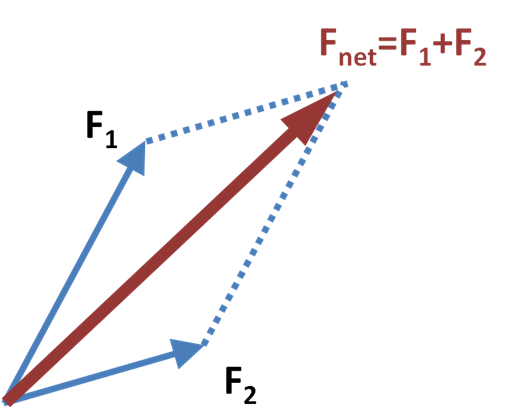 |
| Parallelogram of forces: when forces F1 and F2 are the only forces affecting a thing the resulting movement is described by their sum |
The mathematics of
forces is one step in Wolff's project of quantifying philosophy. A
final step is taken with the notion of grade, which Wolff defines as
a characteristic of qualities that can be used to distinguish
different (spatial or temporal) instances of same quality (thus, two
apples might have a different tinge of green). Now, Wolff notes that
it is possible to create at least a fictitious quantification for the
grades (just think of a temperature scale – if a temperature of air
rises two grades, this does not happen because of adding two
individual grades of warmth to air). Because qualities were
originally the only impediment of the quantification program, Wolff
thinks he has solved the problem suggested by his critics.
The final piece in
separating complex and simple entities is the notion of substance.
Here Wolff begins by distinguishing between what is mutable (that
which can be changed without it losing its essential identity) and what is only perdurable (that which can exist for a time without losing its
essential identity). Now, Wolff's interest lies in perdurable things:
cows, shadows, colours, you name it. Some of these perdurable entities are not
mutable, some of them are. According to Wolff, this distinction
among perdurables captures the traditional distinction between
accidences and substances. This might need some explanation. Consider
a traditional example of an accidence, such as certain shade of
colour. It can definitely exist for a while, say, on some surface,
but when you try to change it, it will change into a different shade.
Then again, a substance, like a cow, will not be destroyed, if you
paint it black – thus, it is not just perdurable, but also mutable.
Wolff's definition
clearly is not meant as a strict division, but more as a hierarchy of
substantiality – that is, we can speak of what is more accidental
or substantial. Thus, we can change e.g. shape of a certain blob of
colour, so that it will still remain a blob of this colour. Then
again certain modifications of cow, such as tearing it apart, will
undoubtedly destroy it. In addition, Wolff suggests we may define as
proper substances those perdurables that will endure through any
humanly conceivable change – these are essentially the simple
substances. Then again, complex substances are in comparison
accidental, because all their essential characteristics, such as
figure and magnitude, are mere accidents. Thus, they can be only
secondary substances.
Wolff ends his
account of simple substances with a consideration of infinities. The
characterisation of an infinite substance contains no surprises –
infinite substance is incomparable with finite substances, but we can
say that it has some analogical or eminent characteristics (eminence
appears to be just a roundabout way to say that we really do not understand
what it is). Then again, Wolff also makes some interesting remarks on
mathematical infinities and infinitesimals. To put short, he admits
that no mathematical infinities or infinitesimals actually exist, but
also suggests that such fictions are useful in e.g. differential
calculus.
So much for simple
substances, now it is only relations we have to speak of.
torstai 24. marraskuuta 2011
Christian Wolff: Reasonable thoughts on God, world, and human soul, furthermore, of all things in general - Units of force
I have always found the concept of
infinity, as used by many historical philosophers, to be rather
confusing. This is probably due to my own background as a student in
mathematics, where by infinity one means a number so great that all
the regular numbers are way little in comparison. Because the
infinities of which these philosophers speak – particularly God –
are supposedly something beyond numbers, I have tried to avoid the
ambiguous term. Indeed, one of my articles was once rejected, because
the reviewer had something against me speaking of perfections,
instead of infinities. Yet, I still feel that the two concepts are
rather close. Infinite substance, for instance, is something ”way
awesome”, superior in all relevant senses compared to a mere finite
substance – shouldn't we then say that it is perfect in comparison
with the finite substances?
Wolff describes infinity of a thing as
a lack of all bounds (Schranke),
and while he never explicitly defines what he means by these bounds,
he in several occasions appears to relate them with how a thing is
determined and classified. The identification of boundaries and
determination resembles Hegel's statement that ”all determination
is negation”; Hegel says that he borrowed the statement from
Spinoza, and it would be interesting to know how widely it had
circulated.
The identification
of boundaries/negations and determinations may be difficult to
understand. With Wolff, we should remember the notion of essence: a
possible structure, which can be actualised in concrete things.
Essence determines then at least some characteristics of an actual
thing, but other characteristics might be determined by its relations
to other things. These relations, then, are what bound the essence
and divide it into different species: if the essence in question
would be a hole in the wall, the windows and the doors would be
differentiated by their differing relations to persons using them.
The word ”boundary” is here used somewhat metaphorically:
boundaries of a figure are also its relations to the things
surrounding it. Essence and all the relations determine then an
individual thing completely, because by knowing the essence of a
thing and its relations to other things we know everything there is
to know about the thing.
Infinite thing is
then something that is not bounded, that is, it is determined only by
its own essence and not by any relations to other things. In other
words, an infinite thing cannot be distinguished from other infinite
things. Instead, it is completely inclassifiable – it cannot be put
into a same class with finite things, because their nature or essence
is too dissimilar. Thus, all we can do to describe an infinite thing
is to use meaningless superlatives – it is beyond anything we can
imagine, or indeed, just ”way awesome”.
How does the
division of infinite and finite things then relate to the earlied
division of simple and complex things? Wolff notes that infinite
things cannot really change, and by change he means specifically a
change of the bounding relations: an essence of a thing cannot be
changed, but at most one can replace a thing having one essence with
another thing having a different essence. Infinite thing is then all
that it is ”at once” and not by going through successive stages.
Then again, a complex thing might change e.g. its spatial
characteristics, which for Wolff are essentially relations to other
things. Thus, an infinite thing, as atemporal, must be simple.
Complex and
infinite things are then two classes with no common members, but are
there any finite simple things? Well, all the complex things, says
Wolff, must be founded on some simple things, the combination of
which has generated the complex thing. Now, a combination of simple
things is undoubtedly a relation of them, and furthermore, a relation
which might change. Thus, the simple things that are the final
constituents of complex things must be capable of change and
therefore finite.
Boundaries of
complex things can be spatial or relate to the number of things it
consists of, but what about boundaries of a simple thing, which is
not spatial and does not consist of other objects? Remember that by
boundary Wolff refers to a non-essential classification caused by the
relations of a thing to other things. He apparently seems to think
that such a classification must at least be analogical with the
relations of magnitudes. A good example of this sort of scale would
be one consisting of temperatures: temperatures do not consist of
smaller temperatures, although they can be related like one number
relates to another. Wolff calls quantities of such scale grades: this
concept was used later by Kant and Hegel.
Wolff shares with
Kant and Hegel also the idea of relating grades to forces (Kraft).
Indeed, beyond numeric and spatial magnitudes, it is rather
difficult to imagine any quantities, but those which measure the
effects of a thing. For instance, temperature can be quantified,
because a certain grade of temperature has a clear effect on the size
of certain substances. Thus, Hegel later suggested that all
grade-scales are not just similarly structured as scales of numeric
and spatial magnitudes, but also essentially connected to such.
Wolff's simple, but
finite things are thus indivisible units of forces. In this Wolff
appears to move beyond Leibnizian monadology, where the ontological
units were characterised by perception, and towards the
identification of activity as the most essential characteristic of
true existence, which is a common theme in German idealists.
By a force,
furthermore, Wolff does not mean a mere capacity, the activation of
which is completely contingent. Instead, force is active and causes
some effects, unless it is countered by a contrary force.
Furthermore, the force of a finite thing is bounded or has a definite
grade. In other words, the activity of a simple, finite thing is
somehow limited. This limitation is not essential, and the simple,
finite thing could well change it, which proves the possibility of
applying temporal terms to these things.
Wolff does not stop
here, but suggests that simple things are constantly striving towards
changing their boundaries. Wolff's only justification for this
statement appears to be the principle of contradiction: a thing
cannot counteract its own actions. The justification appears once
again
somewhat loose:
although the thing itself cannot nullify its own force, other things
might well affect the thing, that is, if the opposing force is strong enough,
the simple thing becomes to a standstill or even starts to become
weaker. Wolff also apparently thinks that static states of standstill
are merely transitory phenomena, which cannot hinder the almost
constant change of the strength of the forces.

We could thus
picture a finite simple substance through a graph where every moment
of time is connected with some grade in the scale measuring the
quantity of the force. The graph goes up, when the force achieves its
goals, and when it goes down, it is hindered by other forces. In the
shadowy distance above, there is the infinity, unreachable by mere
finite things.
Wolff does not say
as much, but it appears reasonable to suppose that it is this
infinity towards which the finite substances probably strive. The
notion of infinity thus produces an objective criteria for making
value judgements in the realm of finite substances: the more the
finite things resemble the infinite thing, the better they are. We
shall see next time what sort of value scale of things Wolff suggests.
Tilaa:
Blogitekstit (Atom)