In 1735, a translation of the five books of Moses was published in the town of Wertheim by the bookbinder J. G. Nehr. In itself this might sound a harmless event, but the translation was quite controversial. Theologians of the time were quick to point out that the book was rather unorthodox. For instance, it appeared to avoid all references to Godhood containing more persons than one, thus being in complete opposition to the dogma of trinity.
Wolff's opponontes were quick to connect this translation with Wolffian philosophy, although the reason behind this connection seems quite murky – perhaps it was just a case of putting all your enemies into one group. Lange's Der Philosophische Religions-Spötter was more concerned with attacking the Wertheim translation through a heavy exegetical artillery, but it also contained a linking of this translation with Wolff. Lange is quick to point out that the infamous translation reeks of mechanistic philosophy, the supporters of which tend to raise their own understanding above Bible.
While Lange's attack has then little of philosophical value Hoffman's Beweisthümer dererjenigen Grund-Wahrheiten aller Religion und Moralität, welche durch die in der Wolffischen Philosophie befindlichen Gegensätze haben geleugnet, und über den Haufen geworfen werden wollen is once again more satisfying work. True, Hoffman does dedicate the last few pages to attacking the translation, but his main criticism is once again left for Wolff's philosophy.
Even the introduction, usually the least interesting part in the books of this period, has many lovely moments, for instance, when Hoffman declares that there is one thing he disagrees with Lange, who thought that he saw something good in Wolff's philosophy, while Hoffman discerned nothing of value in it. Within few pages Hoffman argues that Wolff's works lack originality and that they are utterly without any practical value – here Hoffman makes fun of Wolff's tips about eating and drinking regularly, as such things must have been told everyone by their parents, and ends up with hinting that Wolff might have fared better with a career in interior decoration, since he appears to be so interested of the topic in his ethics.
This is all, of course, a bit of tomfoolery, but Hoffman soon moves onto more serious issues, for he sees a more alarming weakness in Wolff's philosophy, namely, its incapacity of giving proper foundations to philosophy. True, Wolff does boast of a mathematical method, but by this he means mere syllogisms, which cannot reveal anything new. Hoffman accuses Wolffian logic of containing no logic of probability – and at this point I must wonder, whether he had read Wolff's Latin logic at all, because it does contain some rudimentary work on probabilities.
Problems of Hoffman's interpretation of Wolff increase in the main body of the text, where it comes increasingly clear that Hoffman reads Wolff through pietist specitacles – so full of passages, in which Wolff is seen as a mechanistic Spinozan and immoral atheist, is Hoffman's text. The most Hoffman acknowledges is the possibility that he and his companions just haven't understood Wolff' points, but this is then Wolff's fault, for surely competently learned men should have no difficulties in understanding – a rather naive view, I'd say.
But the most interesting part of the whole work comes when Hoffman drops criticism and tries to argue for the theses that Wolff's philosophy supposedly denies. Of an utmost importance if Hoffman's attack against the principle of sufficient reason. He is quick to point out that he is not speaking for complete randomness of all occurrences. Indeed, the Leibnizian principle works just fine in the realm of passive entities, which cannot determine themselves to anything new, such as material things. If a state of, say, a rock is nor completely explained by its previous state (e.g. if the rock has diverted from its trajectory), then the reason for this change must be found outside the rock.
Case is completely different, Hoffman insists, with entities that can actively make things happen, which are not completely determined by previous states of affairs. Hoffman assures us that this does not mean things coming out of thin air, or even worse, vacuum – there must be something, before something else can arise. What Hoffman wants to argue for is the possibility of events occurring without being completely determined by previous events. There was nothing to say that e.g. God should have created this, or indeed, any world, at this particular moment of time, because it was a completely spontaneous choice on his part.
The non-universality of the principle of sufficient reason is not meant to help only in theological questions, but especially when it comes to freedom of will. Human will is not completely free, Hoffman accepts, because it, for instance, habituates itself to various practices it just follows blindly. Yet, it does occasionally make choices that are completely unpredictable and even chooses things it apparently does not want to do and avoids things it wants.
Hoffman's notion is important as a precursor of Kant's later idea of free will and its spontaneity being somehow against the causality principle. Yet, we might doubt if it really worked as a criticism of Wolff's philosophy. We have seen reasons to suggest that Wolff did not think motives worked like causes do, but perhaps left some room for true choices. In any case, Wolff's principle of sufficient reason is far more complicated than Hoffman realised.
Considering that this post was about Wolff's opponents reading some theological notions to Wolff's works, it will be quite appropriate to begin next time with Wolff's own theological works.
Näytetään tekstit, joissa on tunniste Bible. Näytä kaikki tekstit
Näytetään tekstit, joissa on tunniste Bible. Näytä kaikki tekstit
perjantai 20. maaliskuuta 2015

maanantai 16. maaliskuuta 2015
Baumgarten: Chorographic dissertation, evolving notions of superior and inferior, ascending and descending, which occur in sacred chorography and Uninsignificant philosophical meditations concerning poems (1735)
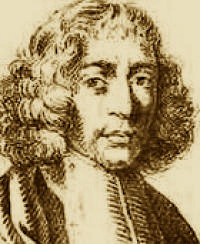 |
| Alexander Gottlieb Baumgarten, 1714 - 1762 |
When Wolff left his
post in Halle because of the atheism controversy, a philosophical
vacuum was all that left. Around the end of 1730s this vacuum was finally
filled by a new eminent figure, Alexander Baumgarten. It is two early
pieces of Baumgarten I am looking at in this post.
The first of these
works, Dissertatio chorographica, Notiones
superi et inferi, indeque adscensus et descensus, in chorographiis
sacris occurentes, evolvens does not deserve a careful
study, because it is mainly of historical worth as Baumgarten's
dissertation. It is not so much a philosophical, but a theological
study of the presence of notions like superior and inferior or ascend
and descend in the Bible. Baumgarten's main point is that while the
words have a literal meaning of higher and lower or moving to a
higher place and moving to a lower place, the words are also used in
a figurative sense: superior is not just physically higher place, but
better, just like Heaven is superior to Earth and Earth superior to
Hell.
Somewhat more
interesting is Baumgarten's work on poetry, Meditationes
philosophicae de nonnullis ad poema pertinentibus, especially as
Baumgarten was later known as the instigator of aesthetical studies –
indeed, the word aesthetics itself is already used in this early
work. Baumgarten shows his clear Wolffian heritage especially in his
manner of carefully defining all the terms he uses in his discussion.
Thus, we hear that oration, for instance, is a series of sounds which
are connected with some significance – ”Peter picked a pickled
penny” is so an oration, because it consists of certain
combinations of sounds that have a meaning. As these combinations or
words have representations as their significance, orations reveal
certain connections between representations.
In poetry, then, the
words signify usually sensuous representations, that is,
representations belonging to what in Wolffian psychology is taken as
an inferior faculty of representation. Of course, even quite prosaic
sentences fall under that description – ”Cat is sitting on a mat”
is not a true poem, but it still refers to sensitive representations
of things like cat, Poetry is differentiated from such sensitive
representations by being more perfect – perfection means here
especially that poems reveal more connections between various
sensuous representations.
This rather
summarised ideal of a poem leads then to various principles of a good
poem – these principles or rules then constitute poetics. Poems
themselves, like all orations, contain three distinct features: the
words themselves as mere sounds, the significance of the words or
representations and their connections. Starting with the first
feature, the words as mere sounds are important only as producing
sensuous pleasure – thus, poems are expected to have pleasing
rhythm and soothing melody.
Most of Baumgarten's
rules concern representations or their connections. Thus, we hear
Baumgarten pronouncing that representations occasioned by poems must
be more vivid than other orations. Thus, these representations must
feature as many aspects of the topic of the poem as possible. Indeed,
the height of poetic perfection is to characterise a complete, living
individual in her full personality.
A somewhat striking
consequence of the demand of vivacity or clarity of representations
occasioned by poetry is that an attempt to go too much into the realm
of fantasy leads to less poetic verses – after all, mere
imaginations seem less vivid than things that we could actually
sense. Mere utopias and impossibilities are not poetic at all,
although internal consistency and coherence might help (thus,
Tolkien's well structured world might still deserve the name of
poetry). Instead of fantasy, the kernel of poetic lies according to
Baumgarten in metaphors, which show deep and unnoticable connections
between different representations.
So much for
Baumgarten's first writings. Next time I'll return to Wolff's
opponents.
Tilaa:
Blogitekstit (Atom)