maanantai 5. toukokuuta 2014

Variety of causes

The world we experience is clearly a world of interacting things, and one rarely finds anything that is completely isolated from its environment. Despite this evident importance, relations have often been relegated into a subservient position in traditional ontologies. It is like philosophers were interested only of classifying things into neat categories, but when it comes to explaining their interconnections, they soon loose their interest. It is then no wonder that Wolffian theory of relations is presented almost as an afterthought, attached to the discussion of complex and simple substances.

Wolff begins with the general notion that a thing is related to another thing – this happens when we consider two things together in such a manner that one of them cannot be understood without a reference to another. Thus, when we think of a person as a parent, we must think of some other person who is a child of this parent. Now, many things could be considered without such a reference to something else, just like we can describe George Bush Senior, without ever invoking any reference to other human beings. Still, we might also consider some aspect of Bush Senior that requires an essential reference to another person, for instance, when we see him as a father of Bush Junior.

These aspects then are relations. Note that with Wolff's definition it is natural to single out the subject of relation, thinking of which requires the reference to someone else, just like consideration of a father requires at least implicit reference to someone to whom he is the father. It just now dawns to Wolff that he has already described several relations, such as equality of quantities or similarity of qualities. There is still no indication that he would have felt a need to transfer his general account of relations to an earlier position in the book.

An important relation is the one between that which contains a reason (principle) for something else (principate). Thus, as forces are a reason for changes in substances, they could be called the principle of change. This leads to a new possible definition of substance. Changes of finite simple substances are based on their inner force and changes of composite substances are ultimately based on the inner forces of their constituent substances, thus all finite substances contain in themselves a principle of change. Then again, accidences cannot really change – that is part of their definition – thus, they also cannot have any principle of change. This only leaves infinite substance out of account, as Wolff admits it cannot really change. Still, Wolff can always fall back to the option of saying that an infinite substance has eminently a principle of change in itself (it does some have force, evidently). Thus, substances can be defined as those entities that have a principle of change in themselves.

Wolff also defines species of different principles. Some principles contain reason for possibilities – in this sense essences are principles of things being modified in a certain manner – while others contain reason for something actually occurring – in this sense modes and other things are principles of thing being modified in a certain manner. Beyond these, there are also cognitive principles, which are essentially propositions explaining other propositions.

Probably the most important point in defining the notion of principle lies in explicating the concept of cause. Simply put, cause for Wolff means a principle, on which the existence of something different depends. Wolff's definition of cause extends far beyond what nowadays is usually called cause, because even if Wolffian cause differs from what it causes, it might still be an aspect or part of the caused, as long as it contributes to understanding why this thing exists. Thus, it is no wonder that Wolff mentions Aristotelian notions of formal and material cause, the former being identified with the essence of the caused, the latter with the constituent parts of the caused, if it has any.

The important notion of cause from the modern point of view is then efficient cause, which Wolff defines as a cause, the causality of which consists of actions – that is, which acts and thus explains the existence of something else. As Wolff's notion of activity is essentially connected with the concept of force, his idea of efficient causality is based on the traditional mechanistic scheme of bodies striking one another and transmitting movement (needless to say, there is no indication in Wolff of the Humean problem how we can recognise causal interactions). Wolff also notes that often one efficient cause is not enough, but the existence of something has required action of many causes, and that efficient causes form series, in which more distant causes lead on to more proximate causes.

Finally, final causes Wolff defines as reasons why an efficient cause starts to act. Final causes are thus causes for efficient causes and thus must precede them, which is only possible, Wolff concludes, if there has been some entity which has previously thought these ends and now decides to actualise them. In effect, Wolff denies the existence of ends without any conscious beings that can set ends to things. Thus, although he has borrowed his scheme of four causes from Aristotle, he clearly rejects some essential underpinnings of the scheme – all events might not have intrinsic final cause. Then again, since Wolff also supposes the existence of an infinite entity or God that has created the world because of its perfection, he would have to admit that all things have some extrinsic end.

In addition to cause, the only relation Wolff dedicates a whole chapter on is the relation between sign and signified. We may leave this topic almost completely untouched and just mention that Wolff admits the possibility of natural signs, that is, things which by nature refer to other things.


So much for ontology then. Next time I will start by looking at a new generation of Wolffians.

torstai 1. toukokuuta 2014

Simplicity itself

As familiar as was his account of complex entities, as familiar is also Wolff's description of simple entities, which in many cases simply have characteristics opposite to characteristics of complex substances. Previously I characterised Wolffian simple things as units of forces, which is quite correct still in light of Latin ontology, but one must not assume that complex entities could not then be described in terms of forces. Instead, the notion of force is something common to both simple and complex entities.

To understand what Wolff means by a force, one must begin with the notion of modes that we know to be characteristics that can be changed without changing the essential identity of a thing. Now, consistent collections of modes define a certain state. Such states, if they happen to be instantiated, belong to some thing, which can then be called the subject of these states, which are then adjunct to the subject. Note that the notion of subject, just like the notion of essence, is context dependent: in geometry we might take certain figure as stable, while in physics this figure could also be mutable.

In some cases, the change of states can be explained through the subject of change – then the change can be called an action of the subject, while in the opposite case it could be called passion. Thus, while if I voluntarily jump from a plane, the subsequent fall is my action, if on the other hand I am thrown from a plane, the fall is my passion. A subject undergoing an action can be called an agent, while a subject undergoing a passion can be called patient.

Furthermore, corresponding to action and passion, a thing has corresponding possibilities for action and passion or active potentiality and passive potentiality, the former of which Wolff also calls faculty. Without these potentialities actions and passions could not occur, but as mere possibilities they still require something in order to be activated.

In case of actions, this activating element is finally called force. What a force is or how it will be generated should not yet be apparent from this nominal definition. Still, it is quite clear from the definition that it makes no sense to speak of a force if there is no action that it activates, unless there is some opposing force resisting this activation.

This is as far as conceptual analysis takes us. From empirical considerations Wolff concludes that we could describe force as consisting of conatus. Conatus is a peculiar notion, common to many early modern thinkers, such as Spinoza, meaning a sort of life force of a thing that aimed at preventing the destruction of the thing. In physical contexts, conatus was often identified with impetus, the habit of bodies to remain in the same state of movement – this tendency was thought to be due to some internal yearning of bodies.

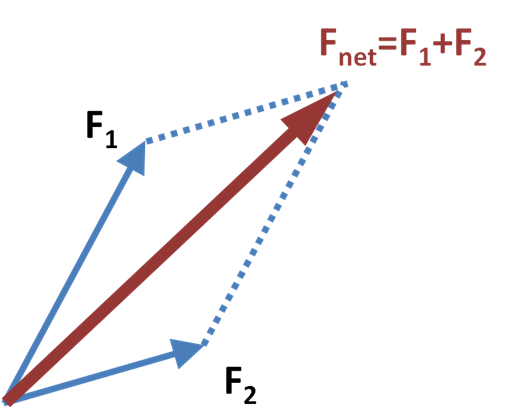
One obvious aim of this talk of conatus or impetus is to introduce the possibility to quantify forces – forces can be connected to the actions they trigger, and we can thus present forces as vectors. Because of their quantitative nature, forces can be combined (basic principle for this possibility is easily seen in a so-called parallelogram of force). Thus, we can regard forces of composite entities as combinations of forces of simple entities.

Parallelogram of forces: when forces F1 and F2 are the only forces affecting a thing the resulting movement is described by their sum


The mathematics of forces is one step in Wolff's project of quantifying philosophy. A final step is taken with the notion of grade, which Wolff defines as a characteristic of qualities that can be used to distinguish different (spatial or temporal) instances of same quality (thus, two apples might have a different tinge of green). Now, Wolff notes that it is possible to create at least a fictitious quantification for the grades (just think of a temperature scale – if a temperature of air rises two grades, this does not happen because of adding two individual grades of warmth to air). Because qualities were originally the only impediment of the quantification program, Wolff thinks he has solved the problem suggested by his critics.

The final piece in separating complex and simple entities is the notion of substance. Here Wolff begins by distinguishing between what is mutable (that which can be changed without it losing its essential identity) and what is only perdurable (that which can exist for a time without losing its essential identity). Now, Wolff's interest lies in perdurable things: cows, shadows, colours, you name it. Some of these perdurable entities are not mutable, some of them are. According to Wolff, this distinction among perdurables captures the traditional distinction between accidences and substances. This might need some explanation. Consider a traditional example of an accidence, such as certain shade of colour. It can definitely exist for a while, say, on some surface, but when you try to change it, it will change into a different shade. Then again, a substance, like a cow, will not be destroyed, if you paint it black – thus, it is not just perdurable, but also mutable.

Wolff's definition clearly is not meant as a strict division, but more as a hierarchy of substantiality – that is, we can speak of what is more accidental or substantial. Thus, we can change e.g. shape of a certain blob of colour, so that it will still remain a blob of this colour. Then again certain modifications of cow, such as tearing it apart, will undoubtedly destroy it. In addition, Wolff suggests we may define as proper substances those perdurables that will endure through any humanly conceivable change – these are essentially the simple substances. Then again, complex substances are in comparison accidental, because all their essential characteristics, such as figure and magnitude, are mere accidents. Thus, they can be only secondary substances.

Wolff ends his account of simple substances with a consideration of infinities. The characterisation of an infinite substance contains no surprises – infinite substance is incomparable with finite substances, but we can say that it has some analogical or eminent characteristics (eminence appears to be just a roundabout way to say that we really do not understand what it is). Then again, Wolff also makes some interesting remarks on mathematical infinities and infinitesimals. To put short, he admits that no mathematical infinities or infinitesimals actually exist, but also suggests that such fictions are useful in e.g. differential calculus.

So much for simple substances, now it is only relations we have to speak of.

maanantai 28. huhtikuuta 2014

Complex extension

A clear difference between Wolff's Latin and German books of philosophy is that the more extensive Latin books have also a more detailed structure than their German counterparts. This is also true of Latin ontology. The book began with a section detailing the two basic principles of contradiction and sufficient reason. The second section was then dedicated to explicating the central notion of essence and some related concepts. Finally, the third section dealt with several characteristics common to all entities, such as identity, quantity and truth. Together, these three sections then formed the first part of Wolff's ontology, dealing with things in general.

The second and final part of Wolffian ontology is then about a general classification of things into simple and complex things. The second part contains, quite naturally, one section dedicated to complex entities and another dedicated to simple entities. In addition to these, there's also a section investigating relations between things, probably just because there was no better place for it.

Schematics of Wolff's Latin ontology

Wolff does not add considerable novelties to his account of complex entities in German metaphysics – the important fact is that the essence of a complex or composite entity is based on the essences of its parts and their mutual relations. Parts are then more essential than their combinations, in which they still retain their independence.

Now, when we are conscious of such a combination of several mutually extrinsic things, we see the combination as extended. In fact, we can abstract from all other features of the complex things, but this extension, as we do in geometry. Geometrically we can then define such notions as continuity (when you cannot put anything else between any two parts of a single thing) and contiguity (when you cannot put anything between surfaces of two different things). If two things are not contiguous, one can also define distance as the shortest line between them.

Extension and related notions can then be used to define space. As I've said earlier, Wolff follows Leibniz in accepting the idea of a relational nature of space – space is determined by certain relations between extended objects (distance etc.), so that space wouldn't exist without extended things having those relations. Here Wolff goes even so far to say that absolute space is just a useful fiction that we abstract from the concrete relations of complex things – and same goes for absolute time.

A novelty in Wolff's treatment of space and time in comparison with German metaphysics is that he extends his account to motion. On the one hand, this means just an extension of mathematical treatment of space or extended things to moving things. Lines can be used to describe not just extension, but also motion – Wolff is here expounding basics of vector calculation.

On the other hand, Wolff also suggests that if both absolute space and time are fictions, so must absolute motion be at least partially fictitious. Still, he is not willing to say that motion is completely imaginary. What is imaginary is the idea of motion happening in some absolute coordinate system with fixed places. Instead, motion is just change in the relations of things – a falling ball is, say, coming closer to the ground.

Furthermore, movement is something that is sustained by the moving entity – falling ball has impetus for moving in constant velocity towards the ground. In addition relations to external things can change the status of movement a thing has – a ball is constantly accelerated by something in its fall, and once it has hit the ground, it will stop moving towards the ground.


So much for complex things and their characteristics, next time I'll have something to say about simple things.

tiistai 22. huhtikuuta 2014

Perfectly true order

I can be quite quick with Wolffian notions of order, truth and perfection, since I covered them already while discussing his German metaphysics. Something of a novelty is Wolff's definition of order, which he states to be a similarity in the modes of things either located nearby each other or following one another. Such an order is then an explanation for a certain thing with particular features being in the place it is – for instance, in a well-ordered library, the place of an individual book is explained by the classification system requiring that a book with certain topic is situated in a particular place. In the case of library, the order is contingent or based on the external factor that some librarian has arranged the books in a suitable manner. There is also a possibility that the order is based on nothing but the very essence of the things ordered: this is the case, for instance, in ordered sequences of numbers.

A well-ordered library?


The principle of ordering can be linguistically embodied in a rule or a set of rules, Wolff asserts. The different rules can then be organised into a hierarchy of rules, in which the different subrules are grouped under more general rules – think of an instructional booklet for keeping a library in good order. As anyone with some experience on libraries knows, often librarians have not been able to order all the books perfectly according to the instructions, for instance, due to physical limitations of the library building or insufficient time for organising books. Similarly, there can be defects in all sorts of orderings, which makes it plausible to speak of more and less perfect orders. A complete lack of order or confusion is also a possibility.

Truth in an ontological or transcendental sense of the word or reality, as we might call it, can then be recognised through its orderly nature. Dreams, Wolff continues, are characterised, on the contrary, by a lack of order of confusion. Wolff goes even so far as to suggest that dreams would be contradictory, which can at most mean that they contradict the rules governing true reality, or indeed, almost all sets of rules. Because all things should have some orderliness in them – at least they have an essence that determines their attributes and possible modes – all things are in some measure true, Wolff concludes.

Finally perfection, which Wolff identifies with the scholastic notion of transcendental goodness, is defined as consensus in variety or unity in multiplicity. Perfection must again have its ground, and this ground is the regularity or orderliness of its constituents. Lack of perfection can then be defined as imperfection or evil. This does not still mean that an exception in the orderliness of some structure would entail its complete imperfection. Indeed, the imperfection might be just apparent, because from a more extensive viewpoint the apparent imperfection might be governed by some rule.

One might reasonably ask whether Wolff is smuggling some normative notions into his ontology with these definitions. Indeed, he appears to suggest by associating the notion of orderliness with words like truth and perfection that order is somehow preferable to a lack of order. Why should we assume that reality is well-ordered, instead of being at least somewhat chaotic? And why should we deem regularity as something perfect and worthy to strive for?

The most plausible defense of Wolff is to assume that the definitions as introduced in ontology should as yet carry no normative weight. Instead, the names hint at future arguments in future parts of philosophy, where the notions are shown to coincide with how we usually understand these words. Thus, we might see e.g. in theology that God has created an orderly world and in ethics that regularity is something we should strive for.


So much for these notions, and indeed, so much for general characteristics of all things. Next time we shall look at some complexities of space-time.

lauantai 19. huhtikuuta 2014

Quantities and qualities

A continuing element in Wolff's ontological studies is his habit of bringing in mathematical examples to substantiate the correctness of his analysis. Indeed, Wolff often ends an investigation of some ontological concept by noting that his conclusions concur with the way how the concept has been used in mathematics. For instance, the analysis of similarity works, because it can be applied to similarity of geometric figures.

All this happens not just for the sake of Wolff's love of mathematics, but it is a part of a larger plan, meant to show that the method of mathematics is useful even in philosophical questions. This argument might have been Wolff's answer to criticism of Rüdigerand Hoffman that philosophy as a study of causal relations exceeds the capacities of mathematics as a study of quantities. We shall see later how Wolff conceived the argument go through, when we look at Wolff's discussion of forces.

For now, it is enough to note how Wolff introduces the very notion of quantity. We have to begin with the idea of unity – idea that things with certain features form an inseparable whole. There is no criterion to say when a thing or entity is such an unity, Wolff says, because all things just are unities, or being equals oneness. Here Wolff is following a tradition beginning from Aristotelian Metaphysics and inscribed in the medieval notion of unity as a transcendental – a property of all things.

What is important in this unity of a things is that we can then collect several of such unities or form a multiplicity. In such multiplicities, we can then abstract from the differences of the entities and concentrate on their common features – we can pick out cows on a field and forget the differences in their colouring. Then this multiplicity forms also a unity or is a whole, of which the original unities were parts. Thus, we can get examples of all the different integers. With integers out of the way, Wolff can then define fractions, and in general, all rational numbers through the notion of ratios of integers and then irrational numbers and generally all numbers geometrically, through the notion of ratios of straight lines – every number has to unit a ratio that a straight line has to another straight line.

Numbers have then, for Wolff, a special connection to quantities, which Wolff defines in a rather peculiar manner as that by which one can discern similar things. Wolff is here thinking about the mathematical notion of similarity, according to which e.g. two figures can be similar, even if their sizes are different. Now, noting what shape a figure has requires only a look on this figure itself. Then again, determining what size it is requires relating the figure to something else, for instance, to say that it is twice the size of that figure. Quantities are then in some sense relational features,because by choosing some quantity of the same type as the unit, we can give a precise numeric expression to that quantity. Quantities can thus be also defined as indeterminate numbers or numbers as determinate quantities.

Wolff also uses the idea of quantity to define notions like equality and inequality (respectively, sameness and difference of quantities), greater and less, addition and multiplication. Furthermore, he uses the opportunity to argue for certain basic truths of mathematics, such as the transitivity of equality (that is, the fact that if A equals be B and B equals C, then A equals C). But what is important for now is the definition of the apparent limit of the mathematical cognition, that is, qualities.

I suggested that Wolff takes quantities as relational, but this is only partially true. Certainly the precise numerical expression of quantity is determined by a relation to some given unity. Then again, Wolff is quite sure that a thing has intrinsically the quantity it does have, and only this determination of the quantity requires relating. Then again, we can define another type of intrinsic features, which do not require such relating, but which can be recognised immediately. It is this second type of intrinsic features that defines the class of qualities. At least essential features and attributes of things are qualities, while modes are either qualities or quantities.

At first sight qualities cannot then be expressed numerically, but as we shall see, Wolff attempts to prove otherwise. We shall not consider this topic for a few posts, and indeed, next time I shall look at what Wolff has to say about truth and perfection.

tiistai 15. huhtikuuta 2014

Immutable necessities

Principle of contradiction denies the existence of contradictions, that is, the existence of combinations of contradictories. What then are these contradictories one might ask? Contradictories themselves are a kind of opposites, Wolff answers. Opposites, on the other hand, are such things that cannot exist at the same time, in the same situation (for instance, complete blackness and complete whiteness cannot exist in the same surface). Contradictories are then opposites, one of which must exist in a situation.

It is a well-known fact that when one modal notion (e.g. possibility) is defined, the rest of the modalities can be defined from that beginning. Thus, impossibility is contradictory of possibility: what is not possible, is impossible, and vice versa, and things must be either possible or impossible.

More importantly, when the opposite of something is impossible, this something itself must be necessary. That is, when some situation or thing has no capacity of ever becoming actual, it's opposite must undoubtedly have the power to actualise itself in every situation. For instance, a figure with three sides, but not three angles would be something impossible and could not ever be actualised, thus, if we do have an actual figure with three sides, it must be actualised with three angles. Generally, all such combinations or propositions describing them are necessary, if the predicate could be deduced from the definition of the subject.

Now, there is a special case of necessary propositions, that is, propositions describing the existence of something necessary. Here it is not any feature of the thing that is necessary, but the very entity is supposed to be such that its non-existence would be impossible. In other words, the actualisation of the haecceitas of such an entity would be necessary. Because this haecceitas or individual essence would contain at least implicitly all the predicates of the thing, it could not really have any other predicates. In other words, it could not change into anything else, but would eternally be what it is.

Wolff leaves it open for now, whether there are any concrete necessary individuals – this is a task left for other branches of metaphysics. Then again, Wolff does find examples of more abstract necessary entities. In Wolffian ontological scheme, what is absolutely possible is defined by its non-contradictoriness, and thus, one cannot change what is possible. If something is then possible, it is necessary possible. Then again, essences or coherent combinations of essential predicates correspond to certain possibilities. These abstract combinations or lists of predicates are then necessary, which means merely that it must be possible that some things satisfy these combinations of predicates.

Wolff also points out that there are actually two different concepts of necessity. Firstly, one can speak of necessity plain and simple or absolute necessity – this is essentially what we have considered now. Then again, there is also hypothetical necessity, that is, necessity under some assumption. Wolff's example of hypothetical necessity is the relationship between a feature of a thing determining what other features the thing has: for instance, if a certain figure has three straight lines as its sides, then it is necessary on this condition of its trianglehood that it also has three angles.


This mathematical example is a good point to move to consider how mathematics is presented in Wolff's ontology, which will be the topic of my next post.

lauantai 12. huhtikuuta 2014

Fully determined individuals

In a couples of posts ago, I compared Wolffian things or possibilities with coherent lists of predicates or determinations, as Wolff calls them. Now, he also mentions the possibility that such a thing would be fully or in every possible manner determined. Wolff doesn't really explain what this means, but one might put it like this. Think the aforementioned lists as answers to multiple choice questionnaires, in which one can, with each question, choose one among many possibilities or leave the question unanswered. Clearly, there is the distinct possibility that all the questions of the questionnaire would be answered – then the answers would describe a fully determined entity.

This simile undoubtedly hinges on the assumption that all possible predicates in such lists could be ordered in the form of such a questionnaire – in effect, a space of possible predicates a thing can fulfill. Wolff himself just innocently accepts this possibility, and I shall also not pursue the question whether the assumption is as innocuous as it looks. Indeed, there is no need, as the notion of fully determinate list of predicates could be characterised even without the notion of such a questionnaire. Just think what adding a new predicate to a fully determined list would do: either it would contradict some combination of the other predicates in the list or then be deducible from such a combination. One need then only to take this characteristic as the defining feature of a fully determined thing.

Being fully determined is then what defines an individual thing, according to Wolff. In addition, being fully determined is also a necessary characteristic of all actual things, and indeed, one rarely sees e.g. otherwise featureless birds flying around. In effect, Wolff is here showing his nominalist leanings. Then again, Wolff clearly is not committed to the idea that full determination would define actuality, as some of his successors were to do. This leaves open the possibility of merely possible individuals that are not actualised (say, a person just like me, except with red hair).

Now, Wolff notes that one need not list all the predicates of an individual to define him. Just think of a triangle with all angles equal – we do not need to tell anymore that its sides are also equal, because this follows from the equality of its angles. Clearly then we could have a minimal set of predicates defining an individual entity – indeed, we could probably have many of them or it wouldn't be a unique set or list (for instance, in case of the triangle, the implication goes both ways, so we could as well begin with the equality of the sides). Such a minimal list would then define what could be called an individual essence, but which Wolff prefers to call by the medieval name haecceitas.

Just as we can distinguish those questionnaires that are fully completed, we can also talk about incomplete questionnaires or lists of predicates that can still be consistently augmented by truly new predicates. If a complete determination defined individuals, incomplete determination then defines genera and species. Wolff apparently doesn't use the modern idea of genera and species as sets of individuals or extensions of certain concepts. Instead, Wolffian genera might be called ”incomplete individuals”: we add some determinations to our would-be individual, but leave it otherwise hazy and vague. Of course, such a vague entity cannot really exist, just like there's no generic triangle, but it might be actualised in various individuals that have the exact properties this vague object is supposed to have. We might say the generic entities are fictional, but they are useful for bringing out the various groupings of individuals. Such a vague entity then has some essence, just like individual had its haecceitas: essence is similarly a minimal list of predicates for such a generic entity.

The genera and species or universals form then a hierarchy, arranged according to their level of determination. The ultimate bottom of this hierarchy is formed by individuals, the only truly actual aspect of the hierarchy. Furthermore, Wolff suggests that in well-planned hierarchy the genera correspond not just with some accidental combinations of characteristics, but reveal how the things are produced. In other words, individuals corresponding to same generic entity should have a similar genesis, just like two humans share some points as to how they have been generated. Furthermore, belonging to a certain genus should determine not just some determinate characteristics of a thing, but also all the possible manners how the thing can be modified.


So much for individuals, next time we shall consider Wolff's notion of necessity.